
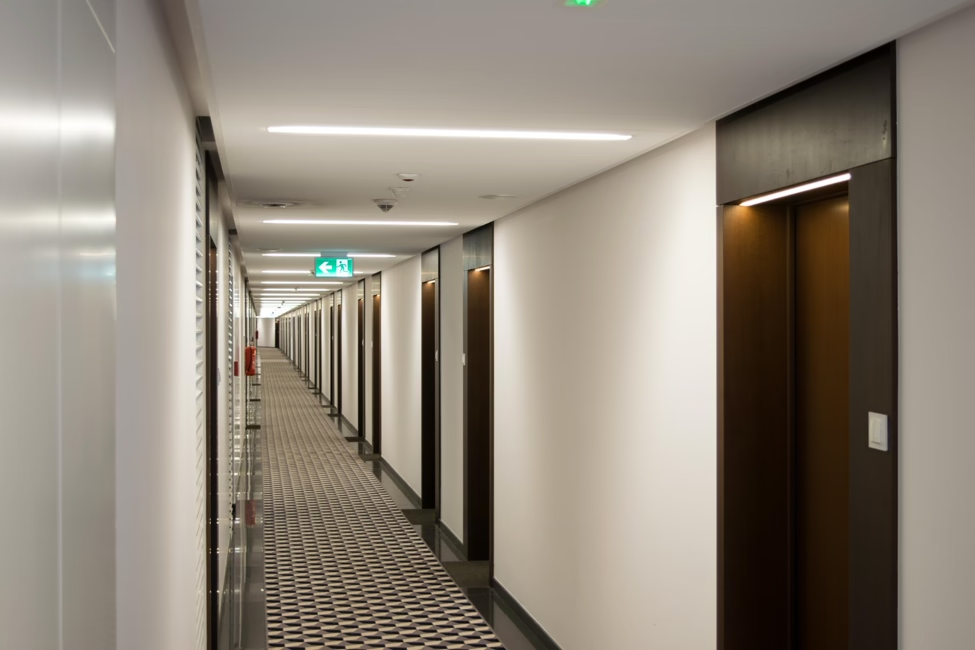
Fire Door Remedial Works and Passive Fire Protection for Hotels
Fire safety remains a critical responsibility for hotel operators, particularly where buildings are occupied around the clock and guests may be unfamiliar with escape routes. Passive fire protection systems are not simply a procedural requirement; they are a fundamental part of life safety within any occupied hotel building.
For hotel estate managers and general managers operating across Scotland and the wider central belt, the question is rarely whether passive fire protection matters. The question is whether existing fire doors, compartmentation measures and passive fire protection systems are properly maintained, suitably evidenced and fit for purpose under current fire safety legislation, relevant British Standards and the building’s fire strategy. In some cases, systems that were previously considered suitable may require review due to deterioration, changes in use, later maintenance works or updated guidance.
What Passive Fire Protection Means in the Hotel Context
Passive fire protection refers to the built-in elements of a building designed to contain fire and restrict its spread without requiring any active response. In a hotel environment, this encompasses fire-resisting partitions, cavity barriers, intumescent seals, fire-stopping around service penetrations and fire door assemblies. Fire doors are commonly specified as FD30 or FD60, meaning they are designed and tested to provide 30 or 60 minutes of fire resistance when installed as part of a correctly specified and evidenced door assembly.
Unlike active systems such as sprinklers or alarm panels, passive fire protection works silently and continuously. When it fails, it often does so invisibly, through gradual deterioration, poorly executed remedial works, missing evidence, incompatible replacement components or installations that no longer align with the building’s fire strategy.
The Compliance Gap in Existing Hotel Stock
A number of hotel properties across the UK operate with passive fire protection systems that were installed some years ago and have not been formally reviewed since their installation. Bedroom corridors may have fire doors that no longer close and latch correctly. Partition walls may have unsealed service penetrations introduced during later maintenance works. Intumescent strips may be absent, damaged, incorrectly fitted or unsuitable for the door assembly.
BS 8214:2026, the current British Standard code of practice for fire-resisting and smoke control doors, provides recommendations for the specification, design, installation, inspection and maintenance of fire door assemblies. The frame, ironmongery, seals, glazing, door closer and supporting evidence should all be considered together. A door that has been rehung, had its hardware replaced, been altered, or sustained physical damage may require further review before it can be relied upon to perform as intended.
For hotel operators, the risk extends beyond the safety of guests and staff. In Scotland, the Fire (Scotland) Act 2005 and the Fire Safety (Scotland) Regulations 2006 place duties on those with responsibility for relevant premises, including hotels, to ensure appropriate fire safety measures are in place and maintained. Failure to comply with those duties can result in enforcement action and, in serious cases, prosecution.
Remedial Works and Upgrading Existing Fire Door Systems
Many hotel properties do not require full-scale refurbishment to address identified fire door or passive fire protection defects. In a significant number of cases, targeted remedial works may be sufficient to improve the performance of existing fire door assemblies, subject to the door’s condition, supporting evidence and the requirements of the building’s fire strategy. These works may include replacing or adjusting ironmongery, installing compatible intumescent seals and smoke seals, adjusting door closers, improving gaps and addressing localised defects.
Where doors or frames have deteriorated beyond practical remediation, or where a property is upgrading to meet a different fire resistance requirement, full FD30 or FD60 door replacement may be necessary. This work should be carried out by contractors with a demonstrable understanding of relevant British Standards, including BS 8214 and BS 9999, and the practical requirements of working in live hotel environments. Programme sequencing, guest safety, access arrangements, dust control and minimal disruption to operations are just as important as technical competence.
What to Look for in a Hotel Fire Safety Contractor
Fire door works require more than general joinery experience. Hotel estate managers should look for contractors who understand fire door assemblies, supporting evidence, compatible ironmongery, installation tolerances, inspection requirements and the operational demands of live hotel environments.
Conspector works within hotel and hospitality environments across Scotland’s central belt, delivering fire door installation, fire door remedial works and passive fire protection upgrades as part of wider refurbishment and maintenance programmes. Our work is led by a qualified Building Surveyor, bringing a strong understanding of building fabric, defect identification, specification and reporting to each project. We work in accordance with current Scottish Building Standards and operate a quality management system aligned with ISO 9001 principles, supporting consistent, auditable delivery across our projects.
If you are responsible for a hotel property and have concerns about the condition of existing fire doors, compartmentation or passive fire protection measures, Conspector can assist with site review, defect identification and a clear schedule of remedial works to support compliance.
Concerned about your fire safety compliance?
If you are responsible for a hotel property and not confident your passive fire protection is fully up to standard, we can help. Get in touch with the Conspector team to arrange an initial site visit, we’ll give you a clear picture of where you stand and if anything at your hotel needs rectifying to ensure compliance. Contact us today.